

Flowers are beautiful and fascinating parts of plants, but they’re more than just pretty decorations. They’re the key to how most plants reproduce, creating seeds that grow into new plants. Think of a flower as a specialized factory designed to make sure plants can pass on their genes.
To do this, flowers have different parts, each with a specific job. This essay will explain flower anatomy in simple terms, breaking down the main parts, what they do, and why they matter. Whether you’re curious about the roses in your garden or the daisies in a field, this guide will help you understand how flowers work.
What Is a Flower?
A flower is a part of a plant that helps it reproduce. Most plants that produce flowers are called angiosperms, or flowering plants, and they include everything from sunflowers to apple trees. Flowers are usually found at the end of a stem, and they’re made up of several parts that work together.
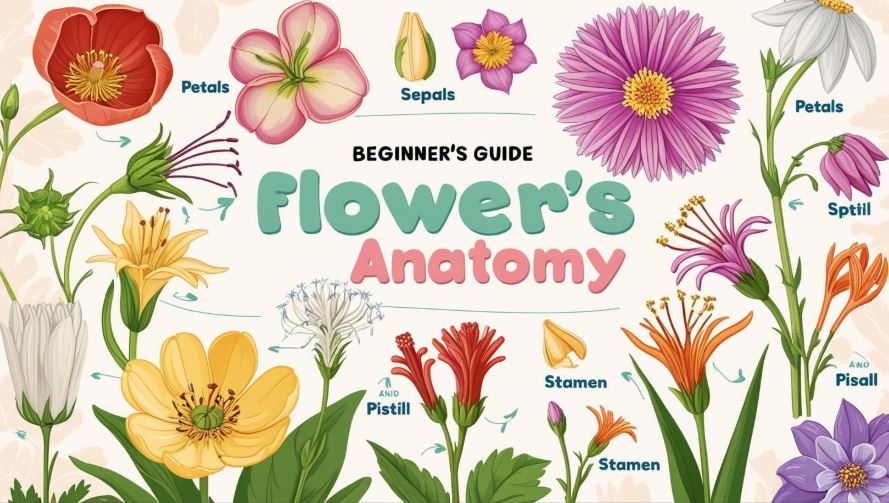
These parts are arranged in layers, like rings, around a central point called the receptacle, which is the base of the flower. The four main layers are the sepals, petals, stamens, and pistils. Some flowers have all these parts (called complete flowers), while others might be missing one or more (called incomplete flowers).
Flowers come in all shapes, sizes, and colors because they’ve evolved to attract animals like bees, birds, or even bats to help with reproduction. This process is called pollination, where pollen (a powdery substance) moves from one flower to another to start making seeds. Let’s explore each part of a flower to see how it helps the plant.
The Outer Parts: Sepals and Petals
Sepals
Imagine a flower bud that hasn’t opened yet. The sepals are the tough, green outer layer that protects it, like a cozy blanket. Sepals are usually leaf-like and form a ring called the calyx around the flower bud. Their job is to shield the delicate inner parts from things like bugs, rain, or harsh sunlight while the flower is still developing.
Once the flower blooms, sepals often stay at the base, looking like small green leaves under the petals. In some plants, like roses, sepals are thick and sturdy. In others, like lilies, they can look colourful and almost like petals. The number of sepals depends on the plant some have three, others have five or more. After the flower opens, sepals might fall off, stay in place, or even help form part of a fruit, like in apples.
Petals
The petals are the colourful, eye-catching part of a flower that we often notice first. They form a ring called the corolla, just inside the sepals. Petals are like billboards advertising the flower to pollinators like bees or butterflies. Their bright colours (red, yellow, purple, etc.), sweet smells, or even patterns we can’t see (like UV markings for bees) are designed to say, “Come here!”
Petals can be soft and delicate, and their shape varies a lot. For example, sunflowers have wide, flat petals that act like a landing pad for bees, while tube-shaped petals in flowers like honeysuckle are perfect for hummingbirds with long beaks. Some flowers, like grasses, don’t need pollinators and have tiny or no petals because they rely on wind to carry pollen. In certain plants, petals and sepals look so similar that they’re called tepals, like in tulips.
The Reproductive Parts: Stamens and Pistils
The sepals and petals are important, but the real action happens in the flower’s reproductive parts: the stamens (male parts) and the pistils (female parts). These are the parts that make pollen and create seeds.
Stamens
The stamens are the male parts of the flower, and they produce pollen, which is like the plant’s version of sperm. A group of stamens is called the androecium. Each stamen has two main parts:
Filament: This is a thin stalk, like a tiny pole, that holds up the pollen-making part.
Anther: At the top of the filament, the anther is a small sac where pollen is made. Inside the anther, special cells split to create tiny pollen grains, each carrying the male reproductive cells.
When the anther is ready, it opens up to release pollen. This might happen when a bee lands on the flower and shakes the pollen out, or the wind might blow it away. Different flowers have different numbers of stamens some, like roses, have lots, while others, like orchids, might have just one or two. In some flowers, stamens can even look like petals to help attract pollinators, but they don’t make pollen.
Pistils
The pistil is the female part of the flower, often found right in the centre. A group of pistils is called the gynoecium. A pistil has three parts:
Stigma: This is the sticky or feathery top where pollen lands. It’s designed to catch pollen, whether it’s carried by a bee or blown by the wind.
Style: The style is a long, thin tube that connects the stigma to the ovary. It holds the stigma up high so it can grab pollen easily.
Ovary: The ovary is the swollen base of the pistil, like a little container. Inside are ovules, which are like plant eggs. After pollen reaches the ovules, they can turn into seeds.
Some flowers have one pistil, while others have several. The ovary’s position also varies it might sit above the other parts (called a superior ovary, like in lilies) or below them (an inferior ovary, like in apples). After pollination, the ovary often grows into a fruit, like a tomato or an orange, with the seeds inside.
How Flowers Work: Pollination and Seed-Making
Now that we know the parts, let’s see how they work together. The goal of a flower is to get pollen from the stamen of one flower to the stigma of another (or sometimes the same flower). This is called pollination. Here’s how it happens:
Pollen Release: The anther opens, and pollen is picked up by a pollinator (like a bee) or carried by wind or water.
Pollen Landing: The pollen lands on the stigma of another flower. The stigma’s sticky or feathery surface grabs it.
Fertilization: The pollen grain grows a tiny tube down through the style to the ovary. Inside the ovary, the pollen’s male cells join with the ovule’s female cells. This is called fertilization.
Seed and Fruit Development: The fertilized ovule turns into a seed, and the ovary often grows into a fruit to protect the seeds.
Flowers are super smart about this process. For example, some have bright petals to attract bees, while others bloom at night with white petals to draw moths. Wind-pollinated flowers, like those on corn, don’t need fancy petals they make lots of pollen and have big, feathery stigmas to catch it.
Extra Flower Features
Some flowers have bonus parts that make them even more interesting:
Receptacle: This is the base where all the flower parts attach. In strawberries, the receptacle becomes the juicy part we eat.
Nectaries: These are glands that make sweet nectar, a treat for pollinators. They’re often at the base of petals.
Bracts: These are special leaves under the flower. In poinsettias, the red “petals” are actually bracts, and the real flowers are tiny.
Why Flower Anatomy Matters
Flowers aren’t just pretty they’re vital to life. They help plants make seeds, which grow into new plants, from crops like wheat to trees like oaks.
Flowers also support animals like bees and butterflies, which rely on nectar and pollen for food. About 80% of the food we eat, like fruits, vegetables, and grains, depends on flowers and their pollinators. Without flowers, our world would be hungrier and less colourful.
Flowers also show how plants adapt to their environment. For example, desert flowers might have small petals to save water, while tropical flowers are big and bright to attract birds. Some flowers, like orchids, have super-specialized parts to work with just one type of pollinator. Others, like dandelions, pack many tiny flowers into one head to look like a big flower.
Different Kinds of Flowers
Not all flowers follow the same pattern. Some plants have separate male and female flowers (monoecious plants, like corn) or even separate male and female plants (dioecious, like holly). Some flowers don’t open at all and pollinate themselves, which is handy in tough conditions. Others, like sunflowers, are actually made of hundreds of tiny flowers working together.
Wrapping It Up
Flowers are like tiny, beautiful machines with parts that work together to help plants reproduce. Sepals protect the bud, petals attract pollinators, stamens make pollen, and pistils create seeds.
Each part has a job, and together they ensure plants can keep growing, feeding animals, and beautifying the world. Next time you see a flower, take a closer look you’ll see a masterpiece of nature that’s been perfected over millions of years. Understanding flower anatomy helps us appreciate how important plants are to our lives and the planet.
 Blossoms & Blooms